ADHD Testing & Autism Evaluations for Adults in Middlesex, NJ
In-person in Middlesex, NJ | Virtual throughout New Jersey and Florida


You have spent your whole life feeling like you are working twice as hard as everyone else just to keep up. You have been called too sensitive, too intense, too much, or not enough. You have struggled in ways that do not quite fit the explanations you have been given. And some part of you has always wondered if there is something more going on.
It is not too late for answers. At True Reflections Mental Health Services, we offer comprehensive, neurodiversity affirming ADHD testing and Autism evaluations for adults of all ages in New Jersey and Florida. Whether you are in your twenties and finally ready to understand yourself, or in your fifties and only now discovering the concept of neurodivergence, you deserve a thorough, affirming evaluation that sees the full picture.
Is This Evaluation Right for You?
An adult ADHD or Autism evaluation at True Reflections Mental Health Services may be right for you if:
You have always felt different but never had the language to explain why
You struggle with focus, organization, time management, or follow-through despite genuine effort
You are socially exhausted by interactions that appear effortless to others
You have been diagnosed with anxiety or depression but those diagnoses have never fully explained your experience
You mask so effectively that others have no idea how hard everything actually is
You received a late ADHD or Autism diagnosis recently and want a comprehensive evaluation to fully understand your profile
You suspect you may be autistic or have ADHD but have never been evaluated as an adult
You are a woman who was told everything was fine for years and you are done accepting that answer
What You Will Receive From Your Evaluation
A comprehensive written report. Your full evaluation report (15 to 30 pages depending on the package) documents your complete neurodevelopmental profile, including your strengths, your challenges, and how your brain works across work, relationships, and daily functioning. You will understand not just what you struggle with, but why.
A formal ADHD or Autism diagnosis, if criteria are met, on official True Reflections Mental Health Services letterhead. This documentation is accepted by employers, medical providers, and educational institutions.
Workplace and academic accommodation recommendations. Under the Americans with Disabilities Act, adults with a documented diagnosis are entitled to request reasonable workplace accommodations such as flexible scheduling, remote work, written instructions, reduced sensory stimulation, and extended deadlines. Adults in school are similarly entitled to academic accommodations like extended exam time and note-taking support. Your report gives you the documentation to request either with confidence.
A personalized feedback session. This is not a report dropped into a portal and left unexplained. We sit down together to go through your results in plain language, at your pace, with time for every question you have.
A clear path forward, including guidance on therapy, coaching, community resources, self-advocacy strategies, and next steps tailored to your unique profile and life circumstances.
A diagnosis is not just a label. For many adults, it provides relief, self-compassion, and a framework for finally understanding a lifetime of experiences that never quite fit. It also ensures that any therapy or support you pursue going forward is matched to how your brain actually works, which can make an enormous difference after years of treatment that never addressed the root cause.
The Evaluation Process
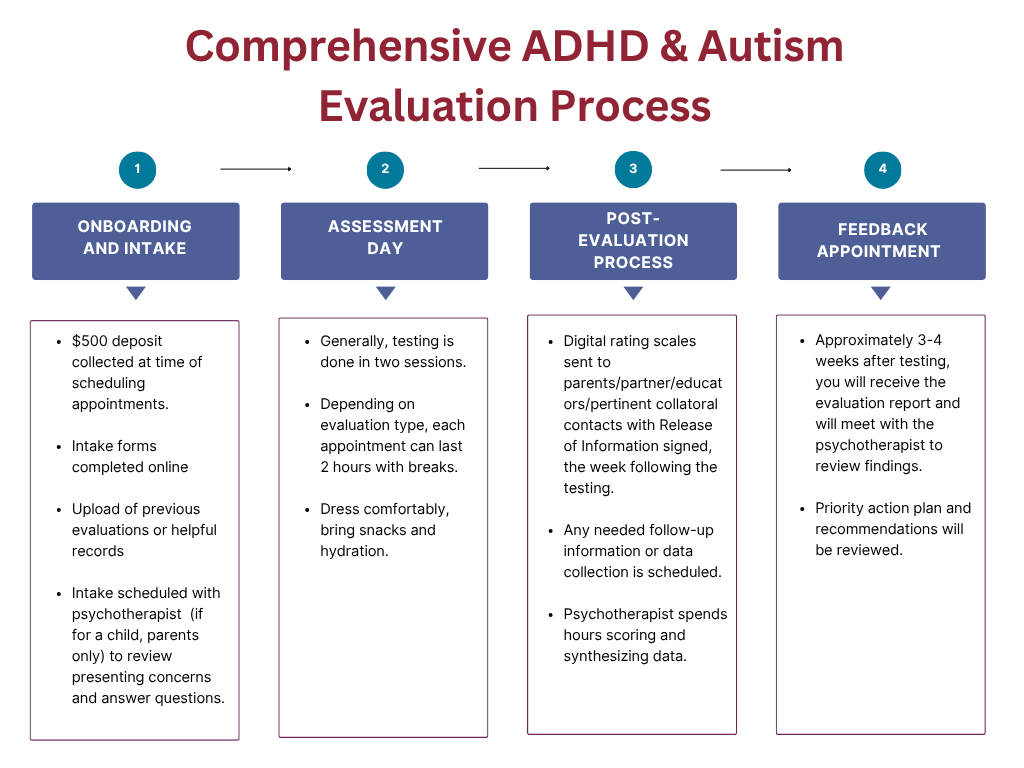
Step 1: Intake appointment. A 45 to 50 minute conversation covering your history, current challenges, and your goals for the evaluation.
Step 2: Testing sessions. You attend one to two sessions of two hours each, depending on the package selected, with assessments chosen based on your unique profile and referral questions.
Step 3: Report preparation. A comprehensive written report documents your full neurodevelopmental profile, diagnosis if criteria are met, and individualized recommendations for work, daily life, and overall wellbeing.
Step 4: Feedback session. A 45 to 50 minute appointment to review results in plain language, answer every question, and confirm next steps.
For more information on evaluations visit our FAQ Page
For information on evaluation fees click here

Specializing in ADHD and Autism in Women
If you are a woman who has always felt different, struggled without clear answers, or been told everything is fine despite knowing it is not, this is for you.
Women with ADHD often present as inattentive rather than hyperactive, appearing organized on the outside while drowning on the inside. Their struggles are frequently internalized as anxiety, depression, perfectionism, or low self-worth rather than recognized as ADHD. Autistic women often develop highly sophisticated masking strategies, sometimes from childhood, mirroring the social behavior of others so convincingly that their Autism goes undetected for decades.
You may have been diagnosed with anxiety, depression, or borderline personality disorder without treatment ever addressing the root of your experience. You may be exceptionally good at appearing fine on the outside while struggling enormously on the inside. Janine Kelly, LCSW, C-NDAAP has dedicated significant clinical training to understanding how ADHD and Autism present in women, including identifying masking and the female inattentive ADHD profile. If a previous evaluation left you without answers, a re-evaluation may finally provide the clarity and validation you have been looking for.

Late Diagnosis in Men: A Different Kind of Missed
Men are missed too, just differently. Men with Autism who are highly verbal, academically successful, or socially functional in structured environments are frequently told they cannot be autistic because they make eye contact, have friends, or held a job for years. Men with ADHD who channeled their hyperactivity into sports, work, or constant activity often make it into adulthood without a diagnosis because they never looked the way ADHD is supposed to look.
What many late-diagnosed men describe instead is a persistent sense of working harder than everyone around them to maintain what looks, from the outside, like an ordinary life: relationships that feel confusing or exhausting, professional environments that are draining in ways hard to explain, and a constant background hum of anxiety or restlessness that has never had a name.
AuDHD: When ADHD and Autism Exist Together
AuDHD describes having both Autism and ADHD at the same time. The two conditions co-occur far more often than previously understood, yet adults are frequently diagnosed with one while the other goes entirely unrecognized, since ADHD can mask autistic traits and Autism can make ADHD present differently than expected.
At True Reflections Mental Health Services, every adult evaluation looks at the full picture, whether you are wondering about ADHD, Autism, AuDHD, or simply searching for an explanation for a lifetime of experiences that have never quite fit.
Why I Do This Work
I know what it feels like to spend your whole life working harder than everyone around you without understanding why. I struggled all throughout school. I was bright, I was trying, and still something always felt harder than it should have been. I did not get accommodations. I did not get answers. I just kept pushing through and quietly wondering what was wrong with me.
As an adult, that pattern continued in ways I could not explain. Tasks that seemed simple for other people took me significantly longer to complete. I would finish a social interaction and feel completely depleted, needing time alone to recover before I could do anything else. I did not know at the time that what I was experiencing was autistic burnout from years of masking. I just thought I was not as capable as everyone else around me.
It was not until I received my own ADHD and Autism diagnosis as an adult that so much of my life finally made sense. And my first feeling was not relief. It was grief. Grief for all the years I had spent masking and overworking and believing I just was not trying hard enough, when what I actually needed was support that matched how my brain works.
That experience is the reason I do this work. Since my diagnosis, I have strategies and accommodations in place that make my daily life genuinely easier and far less exhausting. When you sit across from me in an evaluation, I am not just running through a checklist. I am thinking about how different your life might look with the right framework, the right language, and the right support finally in place. If you have spent years wondering why everything feels harder than it looks like it should be, I want to help you find out.