
A teen or college student can be evaluated for ADHD or autism at True Reflections Mental Health Services in Middlesex, NJ, in person or by telehealth in New Jersey and Florida. The written report can then support requests for school or campus accommodations and help you choose the right kind of support.
The step up to high school and college can feel like a lot all at once. There is more independence, less built in structure, heavier workloads, and social worlds that are harder to read. Plenty of young people who managed well enough in earlier grades hit a wall here, and they often start to wonder why everything takes so much more effort than it seems to for everyone else.
If that sounds familiar, whether you are the student or the parent, you are in the right place.
I am a neurodivergent clinician who was diagnosed later in life, and I know how much effort can go into hiding what feels hard. When I evaluate teens and young adults, I look at the full picture, including strengths, so the results explain the struggle without reducing a person to a label. Many of the students I see have spent years covering up how hard things feel, so good grades or a full friend group on the outside can sit alongside exhaustion on the inside. Others have heard for years that they are unmotivated or disorganized, and they have now started to believe it.
Why the Teen and College Years Are a Common Time to Seek Answers
In elementary school, parents, teachers, and routines do much of the organizing. As students get older, that scaffolding shrinks. Planning, starting tasks, tracking deadlines, handling sensory overload, and keeping up socially all start to fall on the student.
Girls and young women are often missed during these years. Many learn to mask, which means they copy peers and hide differences to fit in. They can earn good grades and look fine while feeling exhausted and overwhelmed in private. If you want to read more about this pattern, see my posts on signs your daughter might have ADHD or autism and the effects of masking in autism.
Signs That May Show Up in Teens
These are common experiences, not a checklist for a diagnosis. Only an evaluation can tell you what is going on.
At School:
Strong ability that does not show up in grades, missing work, or late assignments
Trouble starting homework even when the student wants to do it
Zoning out, losing track of instructions, or feeling mentally tired by midday
Distress about noise, lighting, crowds, or sudden schedule changes
At Home and With Friends:
Meltdowns or shutdowns after a long school day
Friendships that feel confusing, draining, or hard to maintain
Intense interests, strong routines, or a need for time alone to recover
Big feelings over small changes
Signs That May Show Up in College:
College removes most of the structure a student has relied on. Nobody checks in about deadlines, class times change every day, and living with roommates adds new sensory and social demands.
Falling behind even though the student is working hard and cares about their classes
Starting papers or studying only at the last minute, then burning out
Feeling worn out by lectures, dorm noise, and social events
Losing track of meals, sleep, and basic routines
Wondering if they are lazy when effort is clearly not the issue
If you are an adult student, you may also want to read about later in life ADHD and autism diagnosis.
ADHD, Autism, or Both?
ADHD and autism can look alike, can exist together, and can each be mistaken for anxiety. A thorough evaluation sorts out which explanation fits best. For a plain language comparison, read the difference between ADHD and autism or what AuDHD means.
What the Evaluation Looks Like for Older Teens and Young Adults
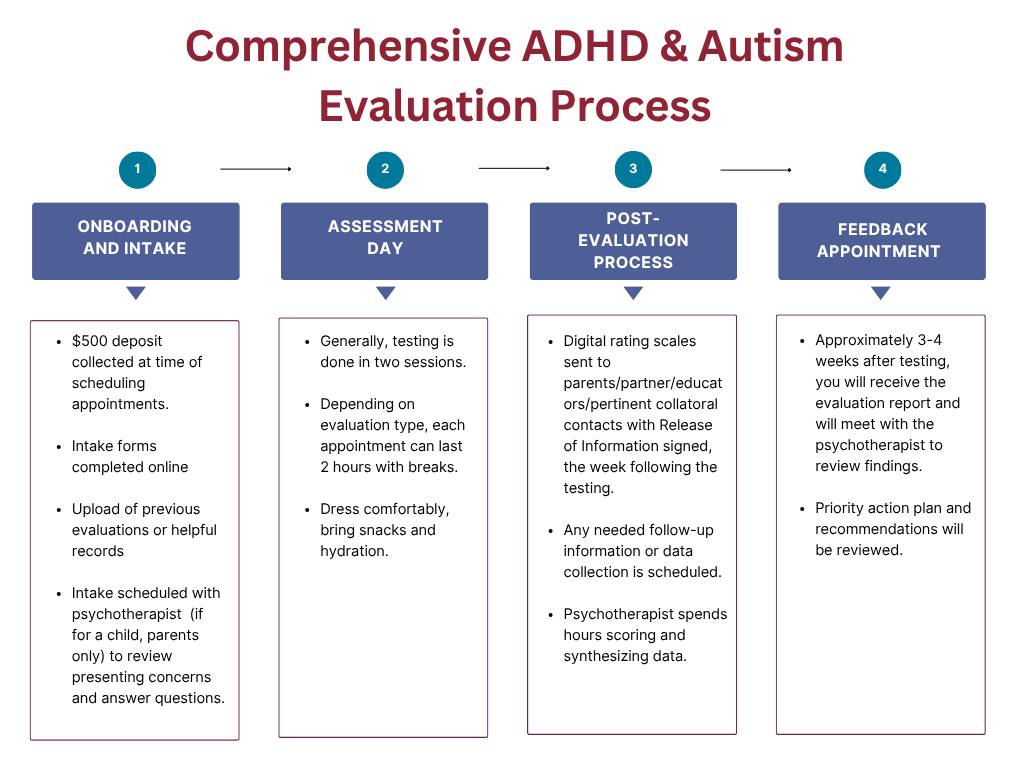
The process starts with an intake appointment that includes a clinical interview. For students under 18, a parent or caregiver often shares developmental and school history. Adult students speak for themselves and help decide who else is involved.
Direct testing follows. For ADHD, this looks at attention, concentration, flexibility, inhibition, working memory, and language. An autism evaluation looks at social communication, sensory processing, behavioral patterns, and identity development.
Most evaluations take 2 or 3 sessions over about 4 weeks, followed by a feedback appointment. You receive a draft of the report before that appointment so you can read it and bring questions. For the full step by step, see what to expect from an ADHD or autism evaluation.
Moving From an IEP or 504 Plan to College Support
What Usually Does Not Carry Over
An IEP or 504 plan from high school generally does not follow a student to college. Colleges are covered by the ADA and Section 504, not the special education rules behind a K to 12 IEP, so the student is the one who has to disclose a disability and ask for accommodations. The best first step is to contact the disability services or accessibility office at the specific school they plan to attend.
How an Evaluation Report Can Help
A current evaluation report gives the student documentation to bring to a college disability services office, along with a clear description of their strengths and needs. Each school sets its own documentation requirements, so check with the college before you book to see what they ask for. No evaluation can promise that a school will approve a specific accommodation.
The U.S. Department of Education's Office for Civil Rights also publishes a guide for students getting ready for college, Students with Disabilities Preparing for Postsecondary Education, which explains the rights and responsibilities of students with disabilities.
If you are comparing options, my post on school evaluations versus private evaluations explains the differences.
If you are a parent of a younger teen, why an evaluation should not wait until the school year gets hard may help too.
Telehealth for Students
Telehealth evaluations are available throughout New Jersey and Florida, and in person appointments are offered at the Middlesex, NJ office. The student must be physically in New Jersey or Florida during the evaluation. A student who is away at school in another state would need to schedule appointments for a time when they are in one of those two states.
The Middlesex, NJ office serves families and students across Central New Jersey, including students who attend Rutgers University, Kean University, The College of New Jersey, Stockton University, Fairleigh Dickinson University, Monmouth University, Seton Hall University, Ramapo College, Montclair State University, and Raritan Valley Community College. Students at colleges throughout New Jersey can choose in person or telehealth appointments.
Cost and Payment
True Reflections is out of network and does not bill insurance. You receive a superbill that you may submit to your insurer for possible partial reimbursement, and HSA and FSA funds are accepted. Payment plans are available for evaluations. See the fees and out of network page for details.
Common Questions
Does my teen need to agree to the evaluation?
The process goes best when they take part willingly. Talk with your teen about why you are considering it and what they hope to learn. Presenting it as a way to understand how their brain works, and not as a search for what is wrong, tends to help. My practice is neurodiversity affirming, so strengths are part of the picture.
Can a college student be evaluated without their parents involved?
Yes. Adult students can decide who participates in the process and who sees the report.
Do we need a referral?
No. You can request an appointment directly. Appointments are usually available within 1 to 2 weeks. See the FAQ page for more answers.
What happens after the evaluation?
You go through the findings together at the feedback appointment, and recommendations might include therapy, accommodations, or other supports. If it fits, you can explore neurodiversity affirming therapy for ADHDers, neurodiversity affirming therapy for autistics, or ADHD and anxiety therapy.
Ready to Understand Your Brain Better?
You do not have to keep wondering why things feel so much harder than they should. If you are a student, or a parent supporting one, I would be glad to talk with you.
Request My Evaluation Appointment
Not sure an evaluation is right yet? You can contact me first.
Janine Kelly, MSW, LCSW, C-NDAAP, ADHD-CCSP, ASDCS, PMH-C, RPT-S™, C-DBT, CBT-C, CCATP-CA is a neurodivergent psychotherapist and the Founder of True Reflections Mental Health Services in Middlesex, NJ. She provides comprehensive, neurodiversity affirming ADHD and Autism evaluations for children, teens, and adults in person and virtually throughout New Jersey and Florida. Janine specializes in the diagnosis of ADHD and Autism in girls and women.
To request an ADHD and Autism evaluation, please click below: